Historical Fiction Reading Challenge: How to Track Books Through Time
I absolutely love historical fiction. There’s something about picking up a book and being transported hundreds, sometimes thousands, of years into the past. One minute I’m exploring ancient India, the next I’m reading about medieval Europe, colonial Ghana or the Second World War.
But recently, while putting together a historical fiction reading list spanning more than 2,000 years, I started thinking about something. How much of history have I actually explored through my reading?
I’ve read plenty of books set during the Second World War, but what about the centuries before that? What about ancient civilisations, the Middle Ages or the 1700s?
That’s what inspired me to start tracking my books by historical period and to create my own historical fiction reading challenge.
If you’re someone who loves books that teach you about history, here’s how you can start your own reading-through-time challenge, organise the historical periods you’ve explored and discover some of the gaps in your reading.
What is a historical fiction reading challenge?
A historical fiction reading challenge encourages you to read books set in different periods of history, rather than simply trying to finish a certain number of books each year.
For example, you might challenge yourself to read a book set in ancient Rome, another in medieval Europe, one during the Industrial Revolution and another during the Cold War.
You don’t have to read them in chronological order either. In fact, I quite enjoy jumping around between different periods, countries and cultures.
What I love about this type of reading challenge is that it encourages you to explore books you might not normally pick up.
And it doesn’t have to be limited to historical fiction. Historical nonfiction, memoirs and biographies can also help you explore different periods of history, although I would keep them in separate categories if you’re specifically challenging yourself to read historical fiction.
Why track the historical periods you’ve read about?
If you’ve been reading historical fiction for a while, you’ll probably have noticed that certain periods come up again and again.
The Second World War is a particularly popular setting, and I’ve read some absolutely brilliant novels exploring different experiences of the war.
But I’ve also realised how interesting it is to read about events that don’t appear quite so often in mainstream historical fiction. I always love finding about lesser known historical events – like missionaries in the Congo through The Poisonwood Bible by Barbara Kingsolver, or strikes in the 1940s in West Africa by reading God’s Bits of Wood by Ousmane Sembène.
For me, reading has always been about more than enjoying a good story. I love learning about the world, discovering different cultures and understanding historical events through the experiences of the people who lived through them.
Tracking books by historical period helps you:
- See which centuries and decades you’ve explored through your reading.
- Discover historical gaps and periods you’ve rarely read about.
- Find inspiration for your next historical fiction book.
- Challenge yourself to read beyond familiar historical settings.
- Build a personal reading history that grows with every book.
It’s also just really satisfying to look back and see how far through history your books have taken you!
How to track historical fiction books by time period
You can start a historical fiction reading tracker with something as simple as a notebook or spreadsheet. The important thing is deciding how you’re going to organise the books.
1. Record when the story actually takes place
First, look at the historical setting of the book rather than the year it was published.
For example, a historical novel published in 2025 but set in the 1800s belongs in your nineteenth-century reading list.
This might sound obvious, but it makes a huge difference when you’re trying to create a timeline of your reading.
For each book, record the title, author and approximate year or period in which the story takes place.
2. Organise your books by century
One of the easiest ways to organise historical fiction is by century.
You might begin with the ancient world, move through medieval history, explore the early modern period and eventually reach the twentieth century.
Here’s a simple example of how you could organise your reading:
| Historical period | Ideas for your reading challenge |
|---|---|
| Ancient world | Ancient India, Greece, Rome and Egypt |
| Middle Ages | Medieval kingdoms, trade routes and empires |
| 1500s–1600s | Exploration, expanding empires and changing societies |
| 1700s | Revolutions, colonial history and everyday life |
| 1800s | Industrialisation, Victorian society and social change |
| 1900s | World wars, independence movements and civil rights |
These are just ideas to get you started. You can take your reading challenge in whichever direction interests you.
And don’t forget that the same historical period can look completely different depending on where in the world a book is set. The nineteenth century in Britain is not the same story as the nineteenth century in India, for example.
3. Track individual decades for more detail
Once you reach more recent history, it can be interesting to break your reading down into decades.
I’ve read lots of books connected to the Second World War, for example, but the early 1900s, 1920s, 1960s and 1980s offer completely different historical experiences.
A book set in the 1940s can teach you something very different from one set during the 1970s.
If you’re using a spreadsheet, you can add a decade column alongside the century so you can see your reading in more detail.
4. Decide what to do with books spanning multiple periods
This is where tracking historical fiction can get a little complicated!
Some novels follow several generations of a family or move between different timelines. Others might begin in one century and finish in another.
My suggestion is to choose the period in which most of the story takes place. If a book covers several equally important periods, you can record more than one.
There’s no need to make this overly complicated. The point is to enjoy exploring history, not spend hours researching the exact dates of every chapter!
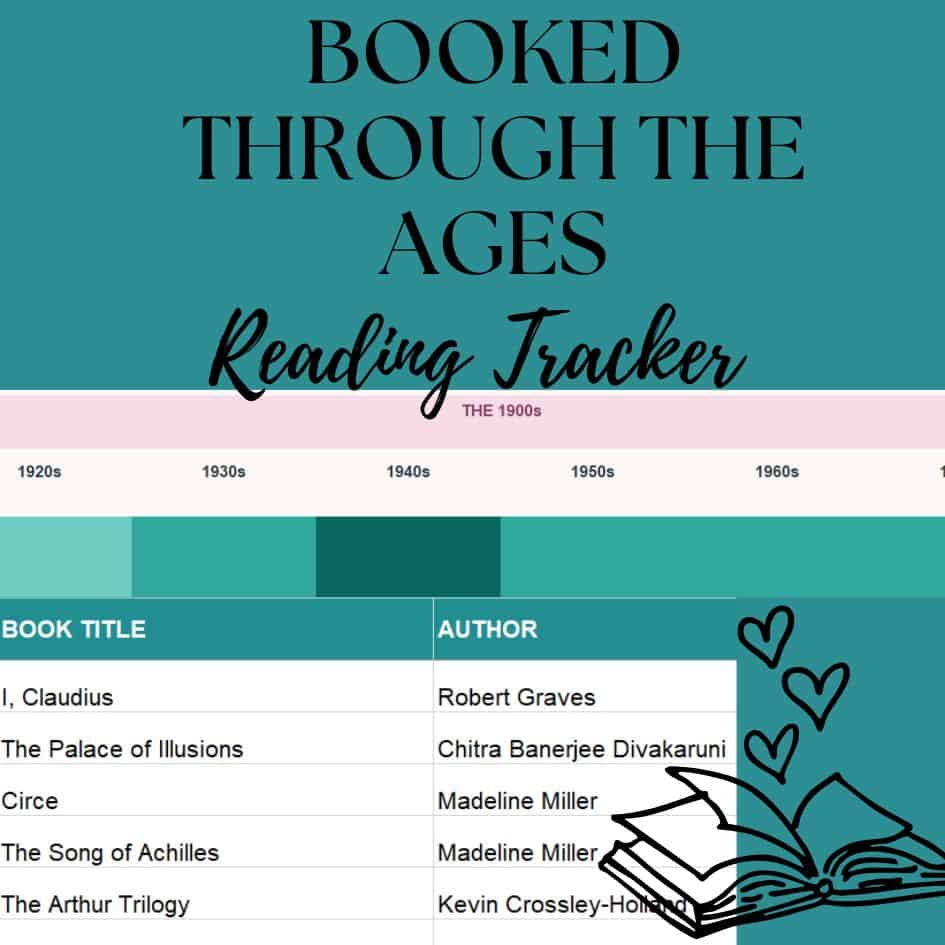
My Historical Timeline Reading Tracker
When I started exploring this idea, I wanted something a bit more interesting than an ordinary reading log.
I love visual reading challenges, particularly when you can actually see your progress rather than simply adding another title to a list.
So I created my own Historical Timeline Reading Tracker, designed to help you organise your books by the historical periods in which they’re set.
It brings together a timeline, a century and decade overview, and a place to enter the books you’ve read.
One of my favourite ideas behind it is being able to spot your historical gaps, those periods you’ve hardly explored at all.
Travel through history, one book at a time
Organise your historical fiction and nonfiction books by time period, explore your reading timeline and discover your historical gaps.
Try this historical fiction reading challenge
If you’re looking for a way to start reading through history, why not challenge yourself to explore ten different historical periods?
I’ve put together a simple challenge that gives you plenty of flexibility with the books you choose.
- Read a book set in the ancient world.
- Read a book set during the Middle Ages.
- Read a book set in the 1500s or 1600s.
- Read a book set in the 1700s.
- Read a book set during the nineteenth century.
- Read a book set between 1900 and 1919.
- Read a book set during the 1920s or 1930s.
- Read a book set during the Second World War.
- Read a book set between 1950 and 1979.
- Read a book set during the 1980s or 1990s.
You could aim to complete the challenge in a year, or take as long as you like. Personally, I prefer reading challenges that encourage me to discover new books rather than feeling like another deadline.
For an extra challenge, try choosing books set in different countries as well as different historical periods.
After all, one of the things I love most about reading is discovering how different people experienced the same events and periods of history.
Where to find historical fiction books from different eras
If you’re struggling to think of books for your historical fiction reading challenge, I’ve got plenty of recommendations to help you.
On my Books That Teach Us YouTube channel, I put together a huge list of 40 historical fiction books spanning more than 2,000 years.
We travel from the ancient world through medieval history, the 1700s, 1800s and into the twentieth century. There are stories set across different continents, exploring everything from ancient civilisations to colonisation, decolonisation, war and displacement.
Every book I recommend in that video is one I’ve personally read, so it’s a great place to find inspiration for your own reading timeline.
Explore my historical fiction recommendations on YouTube.
I also have more bookish tools and reading inspiration on my Reading Resources page.
How to make your historical fiction reading challenge more interesting
Once you’ve started organising your books by period, you might notice a few patterns.
Perhaps you’ve read loads of books set in Victorian England but very few about nineteenth-century Africa or Asia. Maybe you’ve explored ancient Greece through fiction but haven’t read much about ancient India.
Those are exactly the sorts of discoveries that make this challenge interesting to me.
Here are a few ways to take it further:
- Explore the same century in different countries. See how people’s experiences differed around the world.
- Read beyond the most familiar historical events. Look for stories about lesser-known conflicts, societies and movements.
- Mix fiction and nonfiction. Follow a historical novel with a nonfiction book about the same period.
- Read authors connected to the cultures you’re exploring. Seek out different perspectives rather than relying on the same familiar voices.
- Follow your historical gaps. Let the empty periods on your timeline inspire your next read.
It’s not about becoming an expert on every historical period. It’s about being curious, finding wonderful stories and learning something new along the way.
Frequently asked questions about historical fiction reading challenges
What counts as historical fiction?
Historical fiction is generally fiction set in a period before the author’s present, often incorporating real historical events, settings or social conditions. Different readers and publishers use different definitions, so you can decide how strict to be with your personal challenge.
Can I include historical nonfiction in my reading tracker?
Absolutely! If your goal is to explore history through books, biographies, memoirs and historical nonfiction can be brilliant additions. I would simply label the genres so you can distinguish your historical fiction reading from your nonfiction reading.
How do I track books set in ancient history?
For books set in ancient history, record an approximate year, century or historical civilisation where possible. If the exact dates are uncertain, a broad period is perfectly fine. This is particularly helpful with mythology-inspired books, where the setting may not correspond to a precise historical date.
What if a historical fiction book has two timelines?
You can either record both periods or choose the one containing most of the story. If you’re following a specific challenge with rules about historical periods, check how that challenge handles multiple timelines.
Do I have to read historical fiction in chronological order?
Not at all. You can begin anywhere in history and move backwards or forwards as you like. I think part of the fun is following your curiosity and seeing where your next book takes you.
Start reading your way through history
Historical fiction has taken me to so many fascinating places and periods, and I know there’s still an enormous amount of history I’ve yet to explore.
That’s what I love about this challenge. Instead of simply counting how many books you’ve finished, you’re looking at all the different periods, people and events you’ve discovered through reading.
Whether you use a notebook, create your own spreadsheet or use my Historical Timeline Reading Tracker, I hope it encourages you to branch out and find some brilliant new books.
And maybe you’ll discover a whole historical period you never knew you were interested in!
Booked Through The Ages
Track your books, watch your timeline fill with colour and discover time periods you have read…and want to read next!
📚 Your Own Colourful Timeline
📖 Easy to Use Book Tracker
📊 Fun Reading Stats
Secure payment made with Stripe/Google/Apple Pay via Payhip